Build the capabilities your next product roadmap needs.
Turn changing engineering, product and customer-facing roles into AI-native job architecture. Map people’s capabilities against those standards, develop them through practice with Niko and assess internal moves. When you need to hire, Alex runs configurable recruiting workflows against the same requirements—all on one platform.
AI-native job architecture
Demonstrated capability
Develop, redeploy or hire
Your roadmap changes faster than your view of talent.
A new tool changes the work, not just the job description
Define what engineers, product teams and customer-facing specialists need to demonstrate as AI changes their tasks. Give each role and level a standard that HR and business leaders can review.
The capability you need may already be inside the company
A job title or technology keyword does not explain what someone can demonstrate in another role. Compare transferable strengths, remaining gaps and readiness before starting an external search.
Development needs to reach the work itself
An AI course or annual development plan is only a starting point. People need practice on the decisions, workflows and conversations their role now requires.
Define the standard. See the evidence. Decide the next move.
Illustrative workflow
One role standard
Job context
Tasks, responsibilities and level expectations
Structured by Talentpilot
AI readiness
Role criteria
Competencies
Approved by HR and business owners
Illustrative workflow
From evidence to growth
Capability profile
Demonstrated strengths
Gaps against the role standard
Niko
Practice with Niko
Real work. Focused feedback. Another attempt.
Development and internal mobility
Illustrative workflow
Hiring with Alex
Shared role requirements
Sourcing
Screening
Structured interview
Alex
Evidence behind the recommendation
People make the hiring decision
Prepare a solutions engineer for AI-assisted work
Technical hiring grounded in the role you actually need
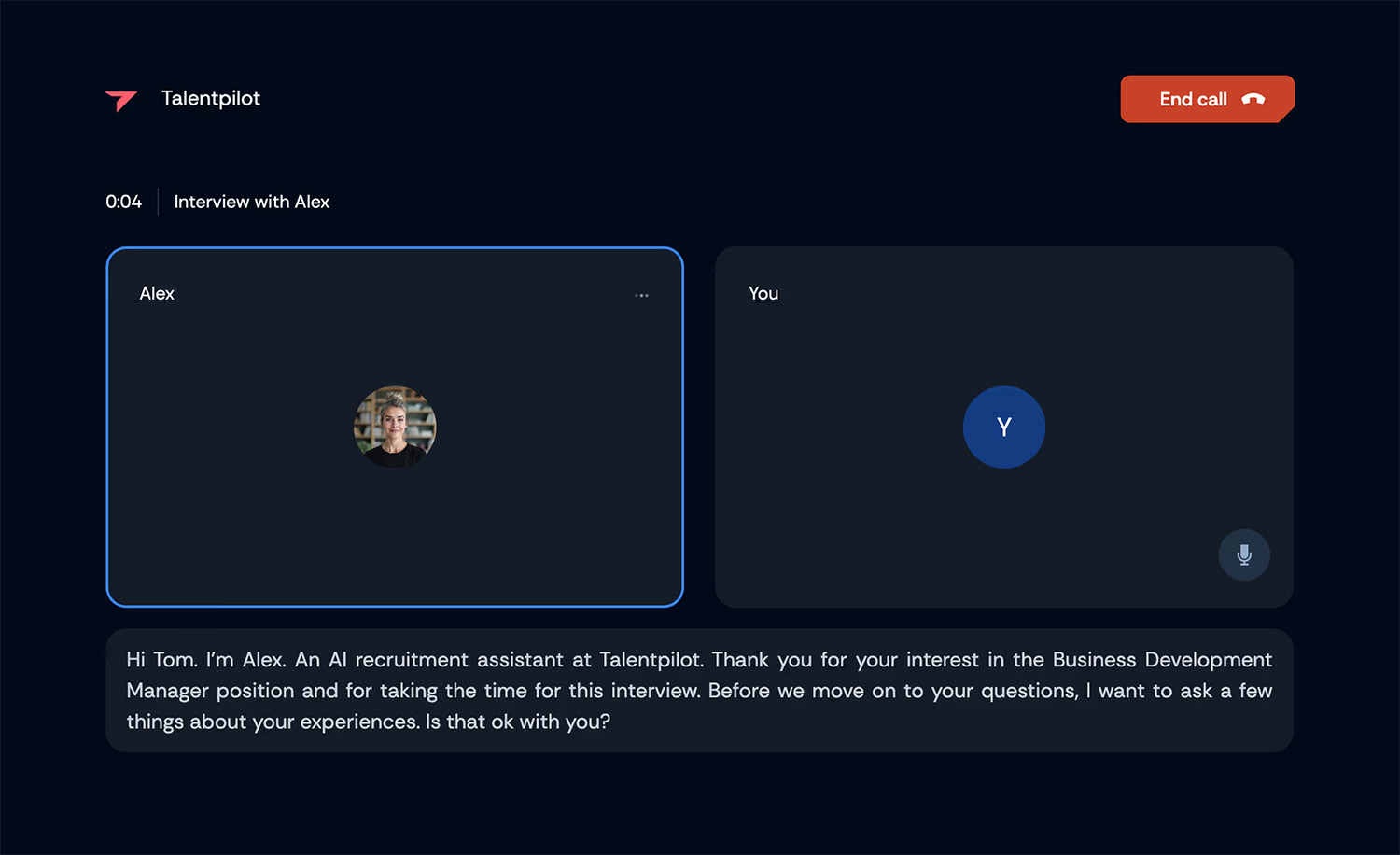
Configure separate screening and interview criteria for the role, reuse your company’s skill rubrics and ground generated questions in your knowledge base. Alex asks follow-up questions in online interviews; reviewers can inspect the supporting transcript passages. A practical work sample can remain a separate step where the role needs one.
Use the same role standard for external candidates and your own people. Hiring evidence can then inform development and onboarding instead of becoming a separate record.
- ✓Source candidates against role requirements and relevant experience
- ✓Review resumes against consistent, approved criteria
- ✓Use company and role context to ground structured interviews
- ✓Ask follow-up questions about specific examples and decisions
- ✓Keep candidate background and interview evidence connected
- ✓Confirm the interview languages and accessibility needs for your hiring markets
- ✓Inspect the evidence behind candidate summaries and recommendations
- ✓Recruiters and hiring managers retain every hiring decision
Help your people grow into the work you need next
A technical profile should show more than a list of tools. Talentpilot compares what people have demonstrated with what their current or target role requires.
Niko turns a development goal into repeated practice: rehearsing a customer workshop, giving difficult feedback or checking an AI-generated proposal. He remembers context, gives feedback after each attempt and follows up on the next step. Role standards and capability mapping connect this practice to team development and internal readiness. With a connected calendar, Niko checks upcoming meetings and proactively offers preparation—for example, a 15-minute rehearsal before a one-on-one.
Illustrative workflow
Build readiness through practice
Role requirement
A clear development focus
Practice with Niko
Practice in real work
Evidence of progress
Back in the capability profile
Review readiness for the next step
- ✓Map strengths and gaps against the same role criteria across teams
- ✓Use structured conversations and relevant experience as evidence
- ✓Inspect why a person appears ready for a target role
- ✓Connect remaining gaps to a focused upskilling or reskilling path
- ✓Practice technical discovery, client workshops and difficult feedback with Niko
- ✓Build AI judgment, workflow design and reusable solutions in the flow of work
- ✓HR and business leaders decide development priorities and internal moves

It's been a long time since a new idea has come to market, but Talentpilot is a great product that has been missing. The guys are helping us with our expansion, and I have to say their customer care is something amazing!

Kateřina Klepková
Head of HR & Recruitment, Smartlook

We are delighted that Talentpilot helps us find our future colleagues not only based on their skills but also on how they 'fit' into the team. It helps us find team players who will fulfill the company's mission with us.

Marcela Svobodová
Marketing Manager, Semantic Visions
One platform, connected to your HR systems

Which tools can we consolidate?

Can we use our existing job architecture?

Where should we start?
Your evidence and security
Human oversight
Data protection
Inspectable evidence
Security review
Start with the role your roadmap needs next.
Bring an existing role description. See the AI-native standard, the capability assessment against it and the practice or hiring workflow that follows.