Build the capability your changing insurance business needs.
Connect the capabilities your insurance business needs with the people who can develop them. Talentpilot brings AI-native job architecture, capability mapping, development with Niko, internal mobility and recruiting with Alex together across claims, underwriting, distribution and service.
AI-native job architecture
Demonstrated capability
Develop, redeploy or hire
Changing work needs more than a bigger hiring pipeline.
AI changes what good judgment looks like in each role
Define the tasks, responsibilities and AI readiness required in underwriting, claims and service roles. HR and business leaders approve the standard before it is used to assess people.
A profile cannot show every capability you need
Use structured conversations and evidence from experience to understand strengths and gaps against the role. Keep professional qualifications and regulated responsibilities subject to your established checks.
Experienced people need a visible path into new work
Compare transferable capabilities and development needs before recruiting externally. A potential internal move should show both its evidence and the gaps still to close.
One standard for development, internal moves and hiring
Illustrative workflow
One role standard
Job context
Tasks, responsibilities and level expectations
Structured by Talentpilot
AI readiness
Role criteria
Competencies
Approved by HR and business owners
Illustrative workflow
From evidence to growth
Capability profile
Demonstrated strengths
Gaps against the role standard
Niko
Practice with Niko
Real work. Focused feedback. Another attempt.
Development and internal mobility
Illustrative workflow
Hiring with Alex
Shared role requirements
Sourcing
Screening
Structured interview
Alex
Evidence behind the recommendation
People make the hiring decision
Help a claims specialist grow into a service role
Consistent candidate evidence across insurance roles
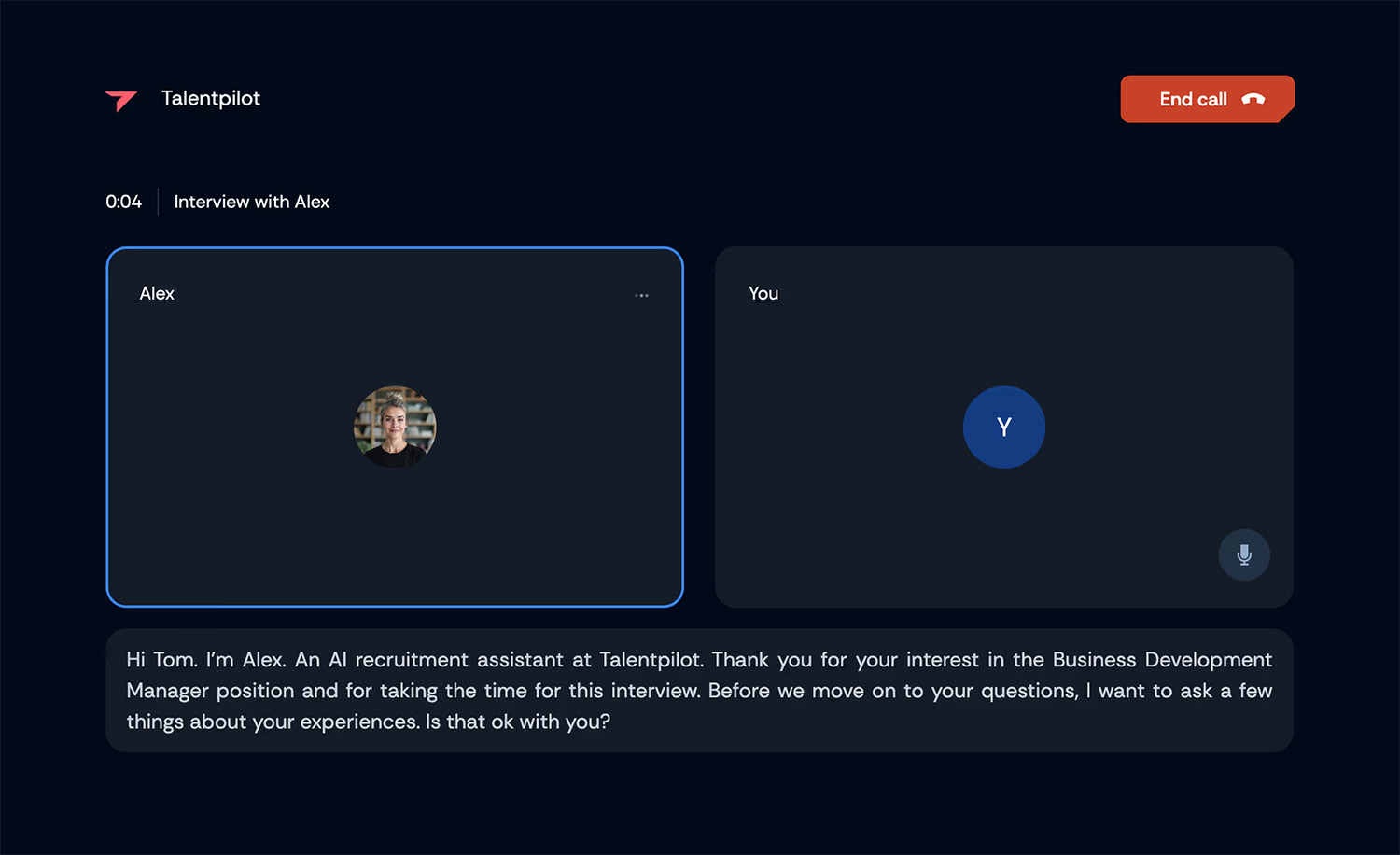
Build separate screening and interview stages for advisors, claims specialists or service roles. Alex uses your criteria and company knowledge, with reusable templates for communication and interviews. Transcript-linked evaluations help reviewers examine answers; professional licensing and qualification checks remain part of your established process.
Use the same approved role criteria for external applicants and internal talent. Relevant hiring evidence can then inform onboarding and development with Niko.
- ✓Review applications against approved role criteria
- ✓Gather interview evidence at times that suit candidates
- ✓Use structured questions and follow-ups about relevant experience
- ✓Ground assessment in your business and role context
- ✓Support recruiter outreach, follow-up and scheduling
- ✓Keep candidate evidence together for human review
- ✓Carry relevant hiring evidence into role-readiness development
- ✓Your team decides who progresses and who is hired
Illustrative workflow
Hiring with Alex
Shared role requirements
Sourcing
Screening
Structured interview
Alex
Evidence behind the recommendation
People make the hiring decision
Help insurance expertise move with the business
A move from claims to a new service role, or from specialist to manager, needs a clear view of transferable strengths. Talentpilot measures capability against the target standard and shows what remains to develop.
For example, Niko can help an employee rehearse a difficult customer explanation or a new manager practice feedback. He gives specific feedback, remembers the context and follows the development goal into the next week. The same practice approach supports checking AI output and learning new workflows; the role defines what matters. With a connected calendar, Niko checks upcoming meetings and proactively offers preparation—for example, a 15-minute rehearsal before a one-on-one.
- ✓Map demonstrated capability against current and target roles
- ✓Use HR-approved expectations at each career level
- ✓Identify specific gaps before an internal move
- ✓Let HR and business leaders review the evidence and priorities
- ✓Build development around real work with Niko
- ✓Rehearse sensitive customer and management conversations
- ✓Track capability progress rather than course completion alone
- ✓Retain human authority over development and redeployment
Talentpilot helped us to better understand what our employees can do but not only that. We used also their psychometric assessments to have really a comprehensive view on people's skills, capabilities and also their unique strengths and characteristics. It made the development much more personalized.
Chief People Officer
Multinational insurance group
One platform, connected to your HR systems

Which tools can we consolidate?

Can we use our existing job architecture?

Where should we start?
Your evidence and security
Human oversight
Data protection
Inspectable evidence
Security review
Start with one insurance role family.
Bring one claims or service role. See how its approved requirements guide capability mapping, practice with Niko and the choice to develop, move or hire talent.